The System of Record Wins the Agent Era
When building an agent gets trivial, the platform that owns the data and the workflow owns the ecosystem. So I bet on the marketplace.
For most of the last two years, the interesting question in my category was whether you could build an agent that actually worked. That question is closing. The models got good enough, the tooling got cheap enough, and the honest truth is that a competent team can now stand up a passable agent for a narrow IT workflow in a few weeks. When the hard part stops being hard, it stops being the moat. So I spent my time on the question I think replaces it. Once everyone can build an agent, who actually captures the value?
My answer is the system of record. Not the flashiest model or the slickest chat window, but the platform that already holds the data the agent needs and sits inside the workflow the agent has to act on. In my world that's the PSA and the RMM together: the tickets, the assets, the contracts, the billing, the record of how this team solved this problem before. An agent is only as good as what it can see and what it's allowed to do, and the system of record is where both of those live. Everyone else is renting context from us.
That reframed the build-versus-buy question at the company level. If building agents is getting easy, the wrong move is to build every agent ourselves and race an endless line of point solutions. The right move is to become the place agents get built on and delivered through. So I launched an agent marketplace. It's a layer where agents that solve real MSP problems, some built by us and some built by other developers, can be published, found, and run against the data and workflows we already own. We announced it publicly, with a partnership behind it.
I want to be precise about where the story actually is, because precision is the whole point of this site. The strategy shipped and the launch is real. The product is early, and I'm not going to dress up traction that isn't there yet. What I can defend is the bet and why I made it.
The bet has three parts, and each one makes the others stronger.
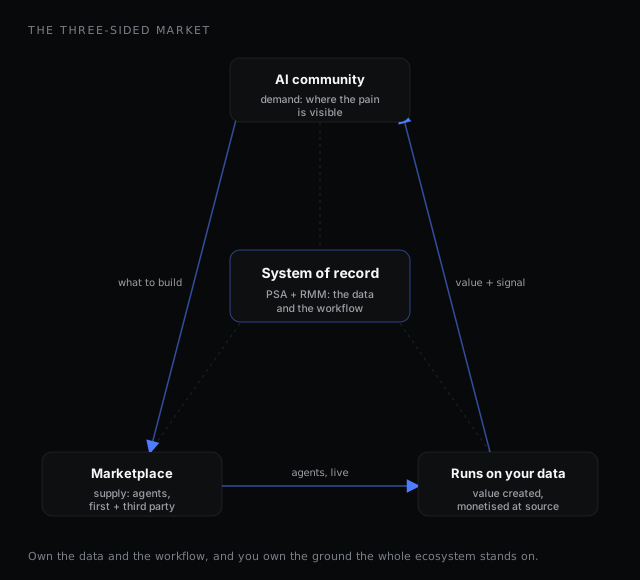
The first is distribution. A developer who builds a clever remediation agent has a distribution problem. They have to go find MSPs one at a time. We don't. We have the customers, the install base, and the workflow surface the agent needs to plug into. Offering them a marketplace is offering them the one thing they can't easily get on their own: reach into the exact accounts where their agent is useful, already wired to the data it needs. That's a trade a rational builder takes.
Distribution is only half of it, though. A builder also has to know what's worth building, and that's the other thing an isolated developer lacks. So alongside the marketplace we launched an AI community, the place where the supply and the demand actually meet. MSPs show up and say here is the workflow that's still killing us. Developers show up and see, in plain sight, which problems are real and which agents people would actually pay for, instead of guessing. The community is the demand signal for the marketplace. It tells a builder what to build before they write a line of code, and it points our own roadmap at the same evidence. Two sides of one market, in one room.
The second is the flywheel, and it's the same shape as the one I keep drawing for our own AI. More agents on the platform make the platform more useful. A more useful platform pulls in more customers and more usage. More usage is more signal and more surface for the next agent. Better agents attract more builders. Our own agents seed the catalog and prove the pattern, and outside developers extend it into corners of the workflow faster than any single roadmap could reach. The system of record is what makes each turn of that wheel compound instead of fragment, because everything runs against one shared context rather than a dozen disconnected integrations.
The third is monetisation, and this is where being the system of record stops being a nice story and becomes a business. When agents run on your platform, against your data, inside your workflow, you're not a directory taking a listing fee. You're the settlement layer. You can price the value the agent creates, share revenue with the builder, and keep the customer relationship, because pulling the agent out means pulling out the workflow it's fused to. The same stickiness that makes our own AI hard to remove makes the ecosystem hard to leave. A marketplace bolted onto a thin tool is a coupon book. A marketplace on top of the system of record is an economy.
Here's what I've learned watching this from the inside. The launch is the easy part, and the press release is not the product. Standing up a marketplace is a strategy statement. Making builders show up, making the agents genuinely good, making a customer trust an agent enough to let it act, that's the work, and most of it is still ahead of me. I'd rather say that plainly than pretend the flywheel is already spinning. What I'm confident about is the direction. The agent era rewards whoever owns the context and the workflow, and turns everyone else into a feature. That's the seat I'm playing for.
So the question I put to every AI story now, mine included, is this. When building the thing gets easy, what do you own that stays scarce? If the answer is a model, you're renting. If the answer is the data the work runs on and the workflow the work happens in, then you own the ground the agents stand on, and you get to decide who builds there and on what terms.
See it live