How I Scope a 0→1 Bet
A new product bet isn't a leap of faith. It's a sequence of cheap questions asked in the right order.
Most zero-to-one bets don't die because the build was bad. They die because the bet was scoped wrong, and nobody noticed until a year of engineering had gone into answering a question that didn't matter. So I've come to treat the scoping itself as the real work. The build is the easy part once the bet is honest.
Here's roughly how I go about it now, learned mostly from the times I rushed it.
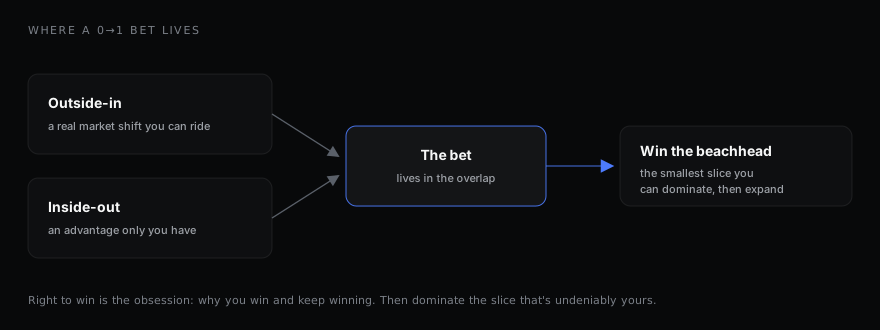
I don't start with what we could build. That's the seductive trap, and it's where most teams begin, because building is fun and market reality is not. I start from two directions at once. Outside-in: what is structurally shifting in the world that wasn't true three years ago, the kind of shift that makes a new thing not just possible but overdue. And inside-out: what do we already have that almost nobody else does, the unfair advantage we would be foolish not to build on. The bets worth making live in the narrow overlap. A shift you can ride, using something only you have. If a bet has only one of those, it's either a feature anyone can copy or a science project chasing a trend.
There are two things I'm almost annoying about from here on. The right to win, and the beachhead.
Right to win is the question I keep coming back to, and it is not "is this an attractive market." Attractive markets attract everyone. The question is why we specifically win it, and just as importantly, why we keep winning it once someone bigger notices. The answer almost always traces back to the inside-out advantage, the thing we have that a competitor can't cheaply copy. If I can't state our right to win in a plain sentence without hand-waving, the bet isn't real yet, no matter how good the market looks. So most of my discovery energy goes at exactly this, because it's the thing that's actually unknown and the thing most likely to be wishful.
The beachhead is the other obsession, and it's where I see good teams overreach. Even with a real right to win, you do not attack the whole market. You pick the smallest, sharpest slice where your advantage is most undeniable, and you win it completely, until you are the obvious choice there and have the reference customers to prove it. The art is picking a beachhead small enough that you can genuinely dominate it, but sitting right next to a much larger market you can roll into once you have momentum. Most teams choose a beachhead that's too big, because a bigger number sounds better in the room. A beachhead you can't dominate isn't a beachhead. It's the whole ocean with optimism attached.
To keep myself honest about what's actually unknown, I split the picture into three. What is already settled, where the market has more or less decided and I don't need to relitigate it. What I already have, the capabilities and the right to play. And what I genuinely have to discover, which is almost always the right to win and the beachhead, on what terms. Most teams burn their discovery re-proving the settled stuff because it's comfortable and it confirms what they hoped. The only questions worth the effort are the ones whose answers could change the decision.
I write down the ways we could win as competing hypotheses, not a single plan I've already fallen for. Three or four distinct framings of what the product even is, plus an open lane for the thing I haven't thought of yet. The job of discovery is not to confirm my favourite. It's to find out which framing real buyers lean into when I am not steering them. Marrying the first framing is how you end up building something elegant that nobody asked for.
Discovery itself I run as a system, not a handful of calls with friendly customers who like me. I want instruments that triangulate. A fast, wide read to see the shape of demand. A structured, deeper survey to pressure-test the specifics with enough people that it stops being anecdote. And time in the room with users, where I get to watch what they actually do rather than what they say they do, which turn out to be different things more often than anyone likes to admit. I show the concept last, on purpose, after I've watched, so I'm reading behaviour instead of leading the witness. Ask "would you buy this" first and you get politeness. Watch the work first and you get the truth.
Price gets its own honest test rather than a hopeful guess, though I've written about that part elsewhere. The short version is that I measure the band buyers will actually tolerate before I anchor on a number I happen to like.
The thing I now refuse to skip is writing the kill criteria down before the data comes in. What result would make us walk away. We decide it cold, in advance, while we still have no ego in the outcome, because the moment the data is in front of you and a quarter of work is already sunk, you will rationalise almost anything into a reason to keep going. Pre-committing to the conditions for stopping is the cheapest insurance a new bet has, and it's the discipline most teams quietly skip because it feels like planning to fail. It isn't. It's the only thing that keeps the decision honest.
All of this collapses into noise without a way to make sense of it on a schedule. So there's one named owner, a living tracker of the assumptions we're testing and where each one currently stands, a standing review on a fixed cadence so it doesn't drift, and a hard date by which a point of view has to be written down and defended. Discovery with no forcing function becomes a swamp everyone wades into and nobody drains. The deadline is what turns a pile of research into a decision.
If I had to compress all of it, the two ways to blow a 0→1 bet are opposite mistakes. One is deciding things you can't possibly know yet, locking the product or the segment or the price before the evidence exists, and calling that guess a strategy. It looks decisive. It's just a frozen bet. The other is never deciding the things you actually could, because more research always feels safer than a call, so exploring quietly becomes the way you avoid committing. The skill is telling the two kinds of question apart. The ones you genuinely can't answer yet, you leave open and keep testing. The ones you have enough to call, you call, and you put a date on them. Match how decisive you are to how much you actually know. The good bets never felt like a leap of faith from the inside. They felt like a sequence of cheap questions asked in the right order, with the courage to walk away written down before we started.