The Operating System Behind a Strategy
I'm obsessed with strategic synergy: getting every function to run the same bet, from the value proposition down to the metrics.
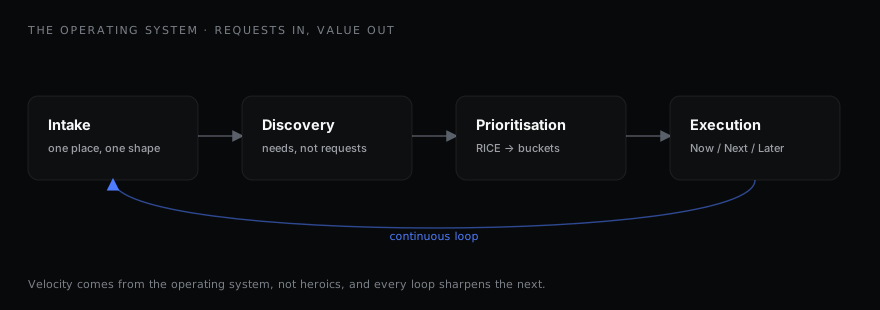
Most teams treat strategy and execution as two separate documents. A strategy deck that lives in a drive, a roadmap that lives somewhere else, and the quiet hope that one turns into the other. It almost never does. The thing I care about more than almost anything is the join between them, what Porter called strategic fit: a set of choices across functions that interlock so tightly a competitor can't copy one piece and get the benefit. That's the obsession. Not a clever feature. A system where every part reinforces every other part.
It always starts with one question for me. What is the customer value proposition, and why is it uniquely ours. Not what we build, but why we win. Once that's sharp, everything downstream has a job. It either reinforces that value proposition or it's noise. The operating model has to serve it. The metrics have to measure it. The bets the team takes have to compound it. When those line up, a company stops feeling like four departments and starts feeling like one argument.
Getting that one sentence right is its own discipline. I land it by reading the market from the outside in and our own capabilities from the inside out, and only trusting a strength that holds up against where the market is actually heading. Then I pressure-test it with the uncomfortable questions. Where could our biggest strength quietly turn into a weakness. Where could a competitor's strength become the thing that trips them up. And I assume any single feature advantage fades in weeks, so the value proposition has to rest on an engine, the data, the workflow, the whole system, rather than on a feature someone can copy by Friday.
The operating model is where that conviction either becomes real or stays a slide. I learned this the hard way in an org where the strategy looked great and was never going to ship. So I built the machine underneath it. Structured intake, so requests arrived in one place in one shape instead of through whoever shouted loudest. Continuous discovery, so we were always separating what customers asked for from what they actually needed. A prioritisation framework that forced trade-offs, where I adapted RICE into buckets we could argue about out loud: moonshots, gold-mines, decent wins, and the questionable. And an execution cadence on a Now, Next, Later roadmap, with squad shapes for the work that never fits the grid. A lane for fires, a lane for deep discovery, and a lane for the experimentation-heavy AI work that needed room to fail.
The part that proves a system is working is what it lets you refuse. We once had a feature with loud sales demand that I put in the questionable bucket and kept there, because it didn't reinforce the value proposition we had chosen. It just chased a deal. Saying no to it was only defensible because the whole system pointed somewhere specific. A strategy you can't say no with isn't a strategy.
Then I wire the metrics to the value proposition, not to activity. This is the part most teams get wrong. They measure output because output is easy to count, and the org dutifully optimises the wrong thing. What gets measured gets done, so the measures had better map to the bet. I lean on a balanced-scorecard logic across four lenses, financial, customer, internal process, and learning, so no single function can look healthy while the system rots underneath it. And I pair metrics on purpose so they can't be gamed. When we shipped agentic work, coverage on its own was a vanity number, an agent that touches everything and helps with none of it. So coverage only counted next to precision. One without the other meant nothing, and the pairing kept everyone honest about whether the AI was actually trustworthy rather than just busy.
The synergy is the payoff. When product, engineering, sales, and marketing are all pointed at the same value proposition and judged on the same outcome metrics, alignment stops being a meeting you have to call. People make local decisions that still add up, because they share one picture of what we're trying to win and how we'll know we have. That is also what turns taking a bet into a team sport instead of a leadership decree. We frame the bet, agree the metric that will tell us it's working, put it on the Now lane, and run it together, with the conditions for walking away written down before we start.
The reason I think this way is simple. Any single thing you do can be copied. A feature, a price, a campaign. What can't be copied is an interlocking system where the value proposition, the operating model, the metrics, and the team's incentives all reinforce each other. That's where defensibility actually lives. So I don't try to win with the best part. I try to build the system where the parts make each other stronger, and then I protect the joins.