When Build and Buy Both Failed
Buying didn't clear the bar. Building wasn't viable. So I designed a third path: a partnership engineered to feel built-in.
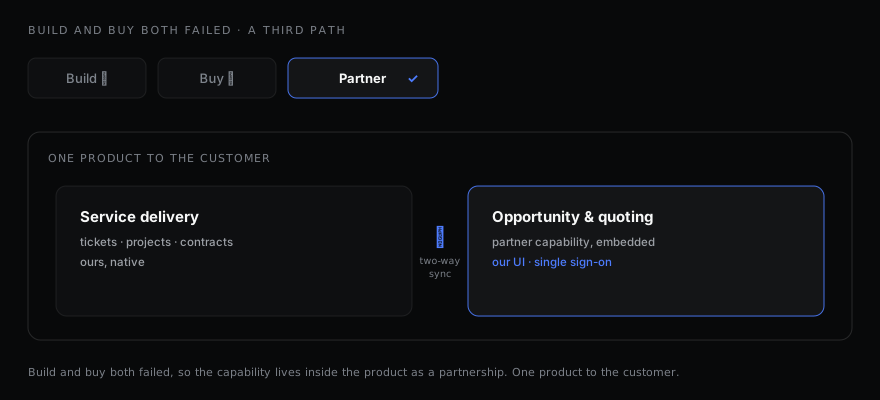
Every MSP we wanted to win had the same broken seam. Their sales lived in one place and their service delivery lived in another, so a deal would close and then somebody would re-key it by hand to actually fulfil it. We didn't have a way to connect the two, and customers kept asking for one. The obvious question landed on my desk. Do we build that capability ourselves, or buy a company that already has it.
The founders asked me to run the product side of the decision and make the recommendation defensible. I want to be honest about the shape of this, because it's where people tend to oversell themselves. The valuation and the deal economics were owned by the CEO's office and the finance team. I worked closely with them, but I wasn't the one modelling the numbers. My job was the product and the strategic fit. Does this capability reinforce what we are trying to become, and can we actually make it work inside our platform without breaking what already works.
Then both of the obvious answers fell apart. Buying didn't clear the bar for the CEO's office and finance. When they looked hard at the economics and the risk, they passed, and they were right to. But building it ourselves wasn't viable either. It was a large, non-core lift that would have pulled the team off the work that actually made us different, and we would have shipped a weaker version of it, slower. Build said no. Buy said no. The customer problem didn't care that both of our options had just died.
So I stopped treating it as a binary, because the binary was the trap. The question I asked instead was simpler. What if we don't build it and don't buy it, but partner so deeply that it feels built in. There was a specialist who already had exactly the capability. What if their product lived inside ours.
That's the version I designed and pushed for, and it's the part I'm proud of. I mapped the whole sales-to-service workflow end to end and designed the experience so the capability sat natively inside our product. Our look and feel. A single sign-on, so nobody ever logged in twice. Sales and service data flowing both ways on their own. A technician or a salesperson would never leave our platform or tab between tools. To the customer it was simply one product. Underneath, it was a commercial partnership. I worked out the packaging so the pricing stayed honest, a lower-cost seat for people who only needed the sales side and full price for those using everything, and I helped shape the terms so we owned the customer relationship and the experience while the partner powered the capability underneath.
The thing I keep from this isn't a framework. It's a reflex. When build and buy both come back as no, that is not the end of the analysis. It's the start of the interesting part. The best answer here was never on the original menu. It looked like product to the customer and like a partnership on paper, and it got people the capability without us betting the roadmap or the balance sheet on it. The first plan didn't survive contact with reality, which is normal. The job was to keep going until I found the option nobody had written down yet.